
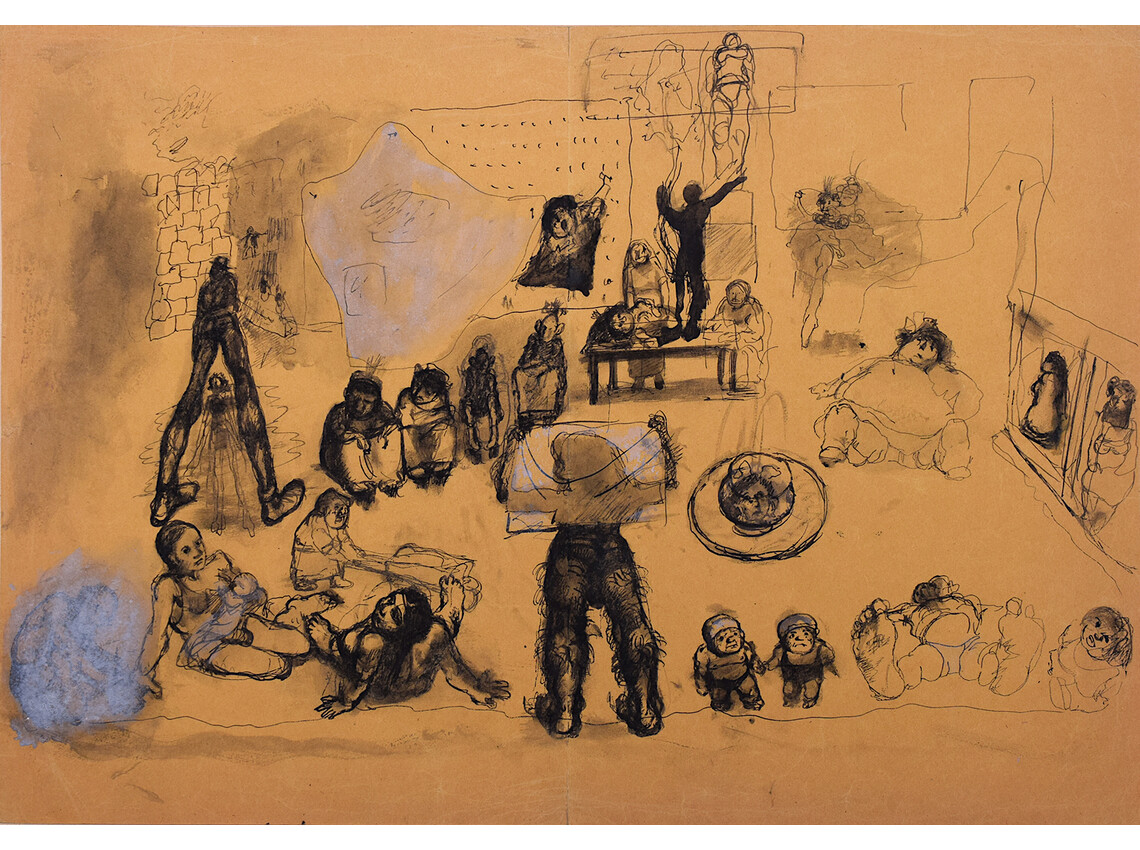
(Moscow, Russia,1898- Grottaferrata, Italie, 1957)
Study for Phenomena, Circa 1936
Ink, ink wash, and white gouache highlights on orange paper
Signature stamp and annotation 346 on the reverse
35.6 x 49.7 cm
Study for Phenomena, the artist's masterpiece held at the Tretyakov Gallery in Moscow
Provenance:
- Collection of Alexandra Fiodorovna Tchelitchev, known as Shoura, sister of the artist and wife of Zaousailloff, Paris
- Private collection (by inheritance), France
- Collection of the Association Les Amis de Pavel Chelitchev, Paris
The painting Phenomena, accompanied by several preparatory sketches, was exhibited in New York at the retrospective Tchelitchew: Paintings and Drawings at MoMA (Museum of Modern Art) from October 28 to November 29, 1942.
Shortly thereafter, SFMoMA (San Francisco Museum of Modern Art) exhibited numerous studies on paper for Phenomena.
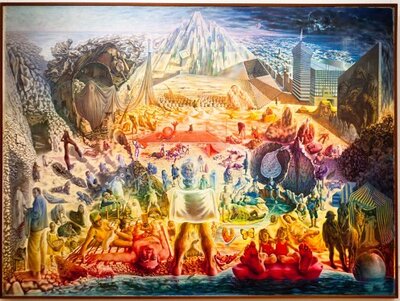
Pavel TCHELITCHEV
PHENOMENA, 1938
Oil on canvas
Tretyakov Gallery, Moscou
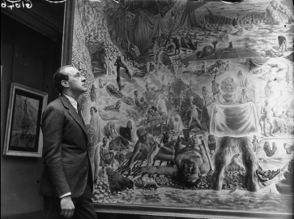
Reg SAYERS, for the Daily Herald, 1938
PAVEL TCHELITCHEV WITH HIS PAINTING “PHENOMENA” AT THE TOOTH’S GALLERY, London, 1938 - Photography
Among the important preparatory works by Tchelitchev held in American museum collections are Study for Phenomena, a gouache and ink work from 1936 belonging to the Museum of Modern Art in New York, and The Fish Bowl (Study for Phenomena), a gouache from 1938, a study for the subject at the center of the final composition, belonging to the Metropolitan Museum in New York.
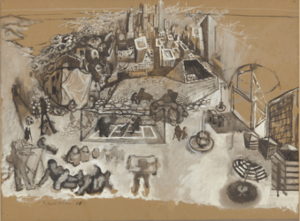
Pavel TCHELITCHEV
STUDY FOR PHENOMENA, 1936
Gouache and ink on paper
45,7 x 61,3 cm
MoMA Collection, New York (nr 445.1974)
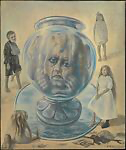
Pavel TCHELITCHEV
THE FISH BOWL (STUDY FOR PHENOMENA), 1938
Gouache
54,9 x 45,7,3 cm
The Met Collection, New York (nr 1974.372)
Phenomena, text by Lyudmila Lebedeva
"The Surrealism of the Kaluga region opens the door to a new understanding of painting. And not only painting, but also the essence of man, his depth, his connection with the timeless and illusory. This cosmic philosophy is captured in the triptych Hell, Purgatory, and Paradise, of which we can only see the first two parts.
Phenomena - Hell. And at first glance, it is a non-systematic amalgam of images, reminiscent of Bosch with his Garden of Earthly Delights, possessing the same frightening frankness and lack of naturalness. But while Bosch's plots are not without sarcasm, Chelitchev's Hell is truly a place of eternal torment.
The composition seems confusing at first, but it is actually inherent in the structure of the pyramid, each row of which carries its own semantic and colorimetric charges. Blocks of ice—the top of the pyramid—rise above the teeming hell, framed by the sea and American skyscrapers. Each row of colors is filled with people, fantastic images, and mini-plots. The ice pyramid below transforms into an Egyptian one, whose base resembles a scorched desert lined with human heads. The next row consists of tents and people dragging meaningless blocks of stone. There are also lifeless bodies, funeral scenes, an absurd tennis court, and a photographer who finds it all entertaining.
The center of the blue “layer” corresponds to the head of the bowl in a glass shell. This may be a reference to the biblical story of the beheading of John the Baptist, whose head was placed on a platter and given to King Herod's daughter. In icons, the prophet's head is usually depicted in the cup as a symbol of divine sacrifice.
The theme of children and motherhood in the “layer” closest to the viewer is presented here as disfigured, turned upside down. A twin baby at the feet of a mother with many breasts, a woman breastfeeding with a fierce look, and a girl with legs disfigured by Chelitchev's perspective. The terrible proximity of the bodies does not speak of cohesion, but only of the loneliness of souls and the complete meaninglessness of what is happening. It seems that the author is obsessed with the idea of a circus phenomenon; he likes physiological pathology. But the artist's goal is not only to arouse disgust and unhealthy interest, but also to stretch an invisible thread between the person contemplating the painting and the mysticism in which he sincerely believed, in which he saw his vocation: "... I have distanced myself from ordinary human understanding, from the meaning of life and a person's attitude to the meaning of the universe - that is why I feel very lonely. I read a lot, I think - my whole life at work - in painting - I love a bridge between science and art - this happens very rarely and this fate has fallen to my lot! " - wrote Chelitchev in 1947.
According to the artist, the inspiration and impulse to create this canvas came to him when he saw the famous bronze door of the Church of San Zeno Maggiore in Verona. This large-scale image was preceded by nearly thirty-five sketches and gouache sketches, now scattered in museums around the world. These are figures and scenes, most of which were later incorporated into the final plot. They are images created by a painful fantasy, imbued with instincts and containing hidden mockery. Of course, Tchelitchev's Phenomena provoked a violent reaction. And the issue was not the assembly of repulsive images and the general vagueness of the plot, even for those who know a lot about the avant-garde. The audience recognized themselves in the heroes depicted on the canvas. Here you can see not only the author himself, brush in hand, but also images of Gertrude Stein, writer Alice Toklas, French artist Leonor Fini, and the author's friend Henry Ford. The naked male figure is Nikolay Magallanes, Chelitchev's famous dancer and model.
This mystical image is not an easy story. “There is no prophet in his own country” - a quote that is incredibly appropriate for Chekhov, like many of those who left revolutionary Russia. He was admired throughout Europe and America, but not by the Soviet Union. Phenomena arrived home according to the author's will in 1958, almost as contraband. The canvas was rolled up and hidden in the scenery of the ballet troupe of Chekhov's friend and choreographer George Balanchine. Phenomena was transferred to the Tretyakov Gallery, where it was kept intact for almost 40 years in storage before being exhibited to the public at the museum".